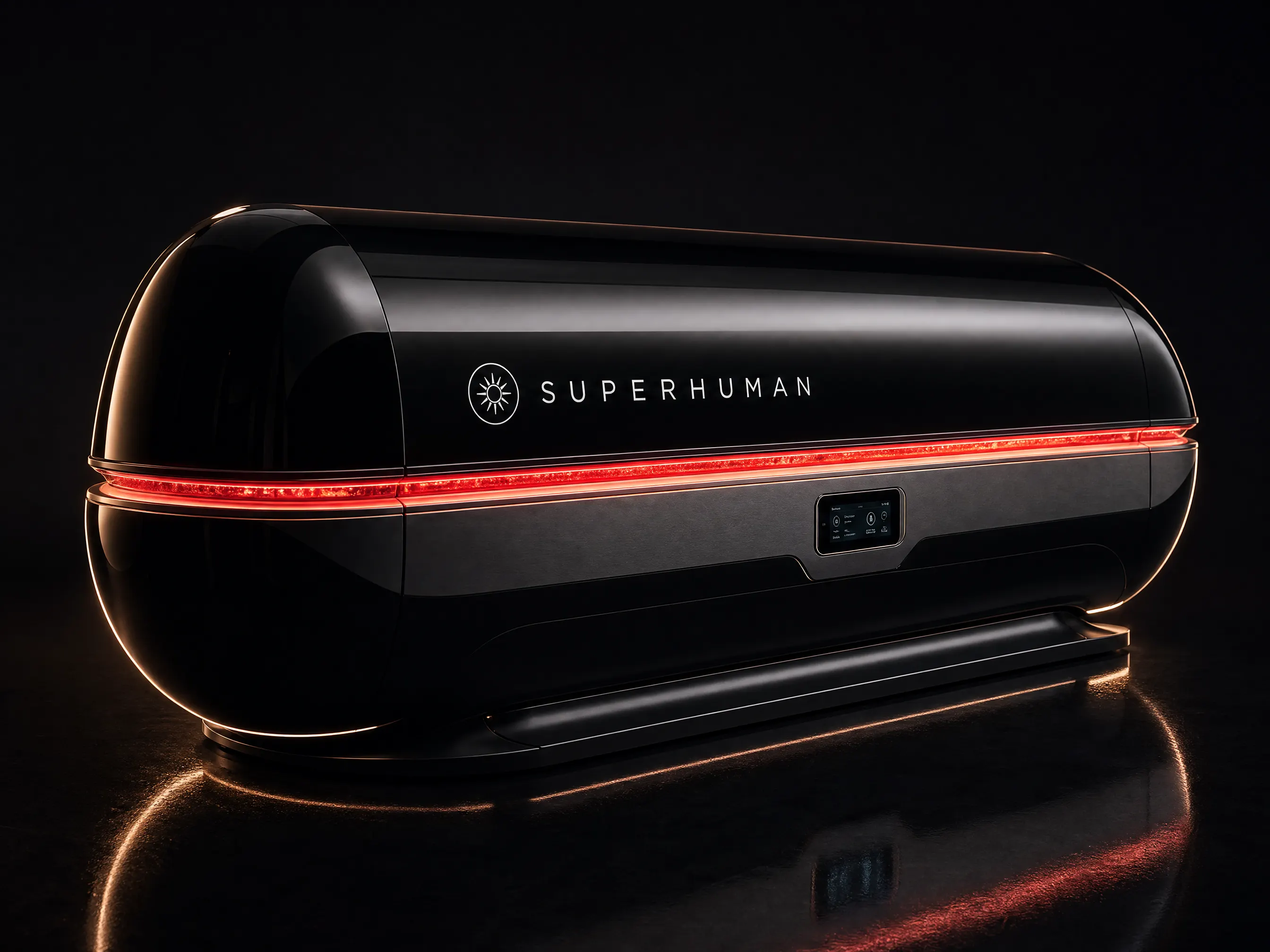
A commercial red light therapy bed is a full-body LED bed built to run paying sessions back to back, all day. It has the cooling, power supply, frame and warranty to handle that load. Entry commercial beds cost $15,000 to $30,000. Our bed, the Superhuman Light R1, is $29,900.
Home and commercial beds use the same words, so it is easy to buy the wrong one. This page explains what makes a bed commercial, gives you a checklist to take to any seller, and shows how different businesses use one.
What makes a bed commercial
Six things separate a commercial bed from a home bed. None of them show up in a product photo.
Duty cycle
Duty cycle is how long a bed can run before it needs to rest. A home bed may be fine for one session and then need to cool down. A commercial bed must run session after session with only a short changeover. Ask the seller: how many sessions in a row, and for how many hours a day, is the bed rated?
Cooling
LEDs turn most of their power into heat. A full-body bed at 5.5 kW puts up to about 18,800 BTU/h into the room while it runs. Commercial beds need heat sinks, fans and airflow sized for constant use. Poor cooling means a hot, unpleasant session and shorter LED and driver life. The room needs ventilation or AC too.
Power
Commercial beds draw far more power than home units. Most need a dedicated 208–240 V circuit. The R1 needs a 40 A breaker and draws about 5.5 kW. A bed that runs on a normal 120 V outlet is almost always a lower-output home bed.
Frame and materials
A commercial bed takes several guests a day, every day. Look for a rigid frame, a high weight rating, strong canopy hinges and an acrylic surface that stands up to repeated disinfecting. The R1 is rated for about 270 kg (600 lb).
Warranty
Read the warranty terms, not just the length. Many home-bed warranties exclude commercial use. A commercial warranty should cover parts and labour, in a business setting, for a stated period. The R1 has a 2-year parts and labour warranty.
Service and support
When a bed is down, you lose bookings. Ask who fixes it, how fast, and whether parts are in stock. Check what training is included for your staff. See our service and warranty page for how we handle it.
Commercial buyer checklist
Take this list to every seller. Get the answers in writing.
| Question | What a good answer looks like |
|---|---|
| What are the wavelengths? | Exact nm values for each band, not “red and infrared” |
| What is the irradiance, and how was it measured? | A mW/cm² figure with the distance and method stated, ideally from an independent test |
| How many LEDs, and what is their rated life? | A count, plus a rated life in hours (the R1 is rated 50,000+) |
| What is the duty cycle? | Rated for back-to-back sessions through a full business day |
| What power supply is needed? | Voltage, breaker size and kW, with a spec sheet for your electrician |
| What room size and cooling are needed? | Footprint, recommended room size and heat output |
| What is the regulatory status? | Clear wording on whether the device is FDA 510(k) cleared for a specific use, or registered/listed only |
| Does the warranty cover commercial use? | Yes, in writing, with parts and labour and a stated term |
| Who services it, and how fast? | A named process, response time and parts availability |
| What is included in the price? | Delivery, install, commissioning, training, eyewear, or a list of extras |
| Is the price public? | Open pricing, with financing options stated |
On regulatory status: an FDA 510(k) clearance means the FDA reviewed the device for a specific use. Being registered and listed with the FDA is a tracking requirement, not a clearance. “Medical grade” has no official definition. Our page on medical grade red light therapy explains the terms.
How the R1 answers the checklist
| Checklist item | Superhuman Light R1 |
|---|---|
| Format | Clamshell full-body bed, front and back treated at once |
| Wavelengths | 630, 660, 810, 850 and 940 nm |
| Irradiance | About 100 mW/cm² at the acrylic surface, independent measurement supplied with quote |
| LEDs | About 36,000, rated 50,000+ hours |
| Modes | Continuous and pulsed, per-wavelength control, session presets |
| Sessions | 10–20 minutes, up to 3 guests an hour |
| UV output | None |
| Power | 208–240 V single-phase, dedicated 40 A circuit, about 5.5 kW |
| Size | 2.2 × 1.2 m, 1.1 m high (about 7.2 × 3.9 × 3.6 ft) |
| Room | About 3.0 × 2.2 m (10 × 7 ft) with ventilation or AC |
| Regulatory | Regulatory and electrical documentation supplied with your written quote |
| Warranty | 2 years parts and labour |
| Included | Delivery, install, commissioning, half-day training, eyewear |
| Price | $29,900, or about $620/mo over 60 months (OAC) |
Superhuman Light R1
Full-body red light, built for a full day of bookings.
- Format
- Full-body bed
- Wavelengths
- 5 · 630–940 nm
- Session
- 10–20 min
- Power
- 240 V · 40 A
Who buys commercial red light beds
Day spas
A red light session fits next to facials, massage and body treatments. It can be sold alone or as an add-on, and it does not need a therapist in the room for the whole session. See red light therapy beds for spas.
Med spas
Med spas often pair red light with skin-appearance services. Keep claims careful: sell it as part of a skin or recovery routine, not as a treatment for a condition. See red light therapy beds for med spas.
Tanning salons
This is the easiest fit. Salons already have the rooms, the booking system and the membership model. A red light bed has no UV, so it adds a service without UV exposure concerns, and it can replace an old UV bed or sit next to one. See red light therapy beds for tanning salons and our comparison of red light beds vs tanning beds.
Recovery studios, gyms and wellness centers
These businesses sell recovery routines alongside cold plunge, sauna and compression. Red light fits into memberships and can run with self check-in.
Cost and return
A commercial bed is a revenue asset, so judge it on payback, not just price. Sessions typically sell for $20 to $100 and cost about $0.25 to $0.40 each in electricity on the R1. Illustrative example: $60 a session × 6 a day × 260 days is about $93,600 a year.
Budget for the one-time costs too: a dedicated electrical circuit, room cooling and an insurance update. Read red light therapy bed cost for the full breakdown, and use the calculator in our ROI guide to model your own numbers.
A note on health claims
Photobiomodulation research is active, and results are mixed. Some specific devices are FDA cleared for specific uses, such as certain pain, hair or skin indications. We do not claim that the R1, or red light in general, treats, cures or heals any condition. Most commercial operators position red light as a wellness, recovery or skin-appearance routine. See what is red light therapy and red light therapy safety.
Next steps
- Check your room size and cooling.
- Ask an electrician about a 40 A, 208–240 V circuit.
- Request a written quote. It includes pricing, the electrical spec sheet, regulatory documentation and lead time.
You can also browse our red light therapy beds or go straight to the R1 product page.