A red light therapy bed costs $1,400 to $22,000 for home use and $15,000 to $30,000 for an entry commercial bed. Premium commercial beds and pods cost $60,000 to $150,000. Our commercial bed, the Superhuman Light R1, is $29,900, or about $620 a month on a 60-month lease.
The sticker price is only part of the cost. This guide covers the price tiers, what drives price, the costs sellers rarely list, and how quickly a commercial bed can pay for itself.
Red light therapy bed price tiers
These are market bands across many brands. They are not our prices, except where noted.
| Tier | Typical price | Who it is for | Typical build |
|---|---|---|---|
| Panels | $99–1,800 | Home users, add-on in a treatment room | One area at a time, plugs into a normal outlet |
| Home beds | $1,400–22,000 | One household | Lighter frame, fewer LEDs, often 120 V, home-use warranty |
| Commercial entry | $15,000–30,000 | Spas, salons, studios, gyms | Full-body, built for back-to-back sessions, 208–240 V circuit |
| Premium commercial | $60,000–150,000 | High-end clinics, longevity centers | Large pods, more LEDs and wavelengths, brand and design premium |
The R1 sits in the commercial entry band at $29,900.
A home bed is not a cheap commercial bed. It is built for a few sessions a week. In a business, it may overheat, wear out fast and fall outside its warranty. If you plan to sell sessions, compare commercial beds only. Our guide to commercial red light therapy beds explains what to look for.
What drives the price
Five things account for most of the gap between a $15,000 bed and a $150,000 pod.
- LED count and coverage. More LEDs across a larger surface cost more. Coverage of the front and back at once (a clamshell design) costs more than a single canopy.
- Wavelengths and control. Beds with several red and near-infrared bands, pulsed modes and per-wavelength control need more complex drivers and software.
- Duty cycle and cooling. A bed that runs all day needs fans, heat sinks and electronics sized for constant use. This is a large part of what makes a bed commercial.
- Regulatory status. A device with an FDA 510(k) clearance for a specific use has been through a formal review. That costs the maker time and money, and it shows in the price. Being registered or listed with the FDA is not the same thing. “Medical grade” has no official definition at all. See medical grade red light therapy.
- Brand, design and service. Premium pods charge for industrial design, brand name and service networks. Some of that is worth paying for. Some of it is marketing.
What does not drive price much: the electricity to run it. That is a small line item, covered below.
Hidden costs sellers rarely list
Budget for these before you order. Figures are typical ranges and will vary by location.
| Cost | What it is | Typical range |
|---|---|---|
| Electrical circuit | A dedicated 208–240 V circuit on a 40 A breaker, run by a licensed electrician | Often $500–3,000, more if your panel needs an upgrade |
| Cooling and ventilation | A 5.5 kW bed puts up to about 18,800 BTU/h of heat into the room while running | Existing AC may be enough; a small split unit often costs a few thousand dollars |
| Eyewear | Protective goggles for guests and staff | Starter set included with the R1; spares are low cost |
| Cleaning | Acrylic-safe disinfectant and wipes after every session | A few dollars a day |
| Insurance | Add the service to your professional or general liability policy | Ask your broker; varies by state and policy |
| Room fit-out | Flooring, lighting, a chair and hooks for clothes | Depends on your space |
| Delivery and install | Freight, positioning, commissioning | Included with the R1; often extra elsewhere |
Two tips:
- Get an electrician’s quote early. The electrical work is the cost most buyers miss. We send an electrical spec sheet with every written quote. See installation.
- Plan the room for heat. The R1 needs a room of about 3.0 × 2.2 m (about 10 × 7 ft) with ventilation or AC. A hot room makes for a poor guest experience and shortens electronics life.
How to compare quotes
Two beds at the same price can be very different deals. Put every quote on the same sheet before you decide.
- Line up what is included. One seller’s $25,000 may not include freight, install or training. Another’s $30,000 may include all three. Add the extras back in.
- Compare output, not LED count. Ask for irradiance in mW/cm² with the measuring distance stated. An independent test is better than a brochure number.
- Check the warranty wording. Confirm it covers commercial use, parts and labour, and who pays for the technician’s visit.
- Ask about lead time. A bed that arrives in four months costs you four months of sessions.
- Get regulatory status in writing. “FDA registered” and “FDA cleared” are not the same thing. Ask which one, and for what use.
- Price the total over five years. Add the purchase or lease, electrical work, cooling, electricity and any service plan. That number is what the bed really costs.
Most price guides online are written by a seller recommending its own bed, and ours is no exception. That is why we publish our price and our specs, and why we suggest you get quotes from other brands too. Our brand comparison is a good place to start.
Running cost per session
The R1 draws about 5.5 kW. A 20-minute session uses just under 2 kWh. At $0.13 to $0.20 per kWh, that is roughly $0.25 to $0.40 per session. At busy commercial use, electricity runs about $60 to $120 a month.
LEDs are rated for 50,000+ hours, so there are no tanning-style lamps to replace. Your main ongoing costs are cleaning, staff time and any lease payment.
Financing and leasing
You do not need to pay cash. Most commercial buyers finance or lease.
- Lease: the R1 is about $620 a month over 60 months, on approved credit.
- Equipment finance: loans from your bank or an equipment lender, secured on the bed.
- Buy outright: $29,900, with no interest cost.
At $40 a session, about 16 sessions a month cover a $620 lease payment. That is fewer than four sessions a week. See financing for terms.
ROI summary
Commercial red light sessions typically sell for $20 to $100. An illustrative example, not a forecast:
- $60 per session × 6 sessions a day × 260 days = about $93,600 a year in revenue.
- Electricity at that volume is well under $1,000 a year.
- At that pace, a $29,900 bed pays for itself in a few months.
A slower start is more realistic for most new services. At $40 a session and 3 sessions a day, 26 days a month, revenue is about $3,100 a month, so the bed pays back in about 10 months before staff and rent. Your numbers depend on pricing, demand and how you sell sessions. Use our ROI calculator to model your own.
Our bed: the Superhuman Light R1
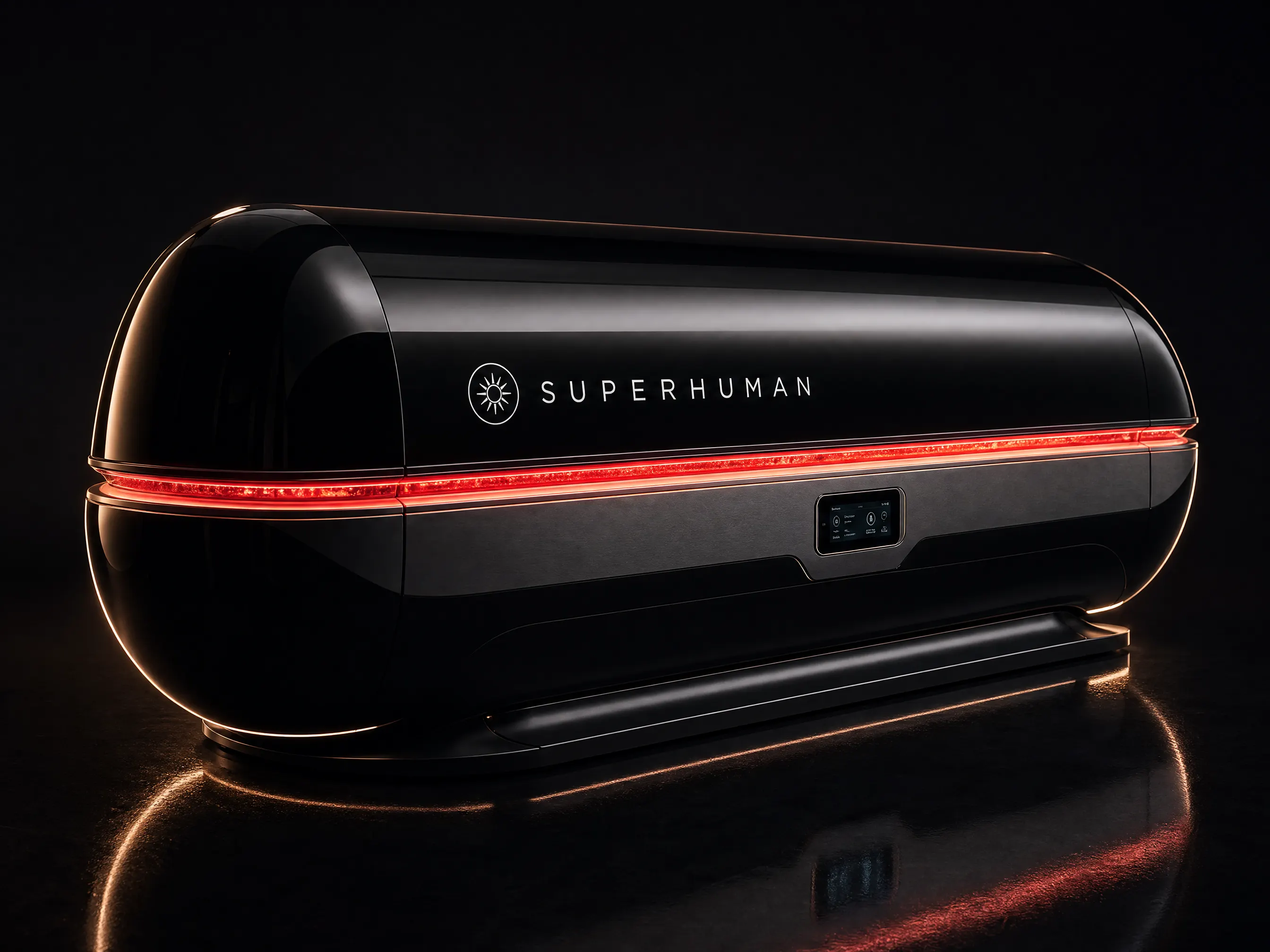
Superhuman Light R1
Full-body red light, built for a full day of bookings.
- Format
- Full-body bed
- Wavelengths
- 5 · 630–940 nm
- Session
- 10–20 min
- Power
- 240 V · 40 A
The R1 is a commercial clamshell bed. It treats the front and back of the body at once with 5 wavelengths (630, 660, 810, 850 and 940 nm) from about 36,000 LEDs. Irradiance is about 100 mW/cm² at the acrylic surface, with an independent measurement supplied with your quote. It runs continuous and pulsed modes, sessions of 10 to 20 minutes and up to 3 guests an hour. No UV.
Regulatory and electrical documentation is supplied with every written quote. We do not claim that red light treats or cures any condition. Research into photobiomodulation is active and results are mixed; see what is red light therapy for an overview.