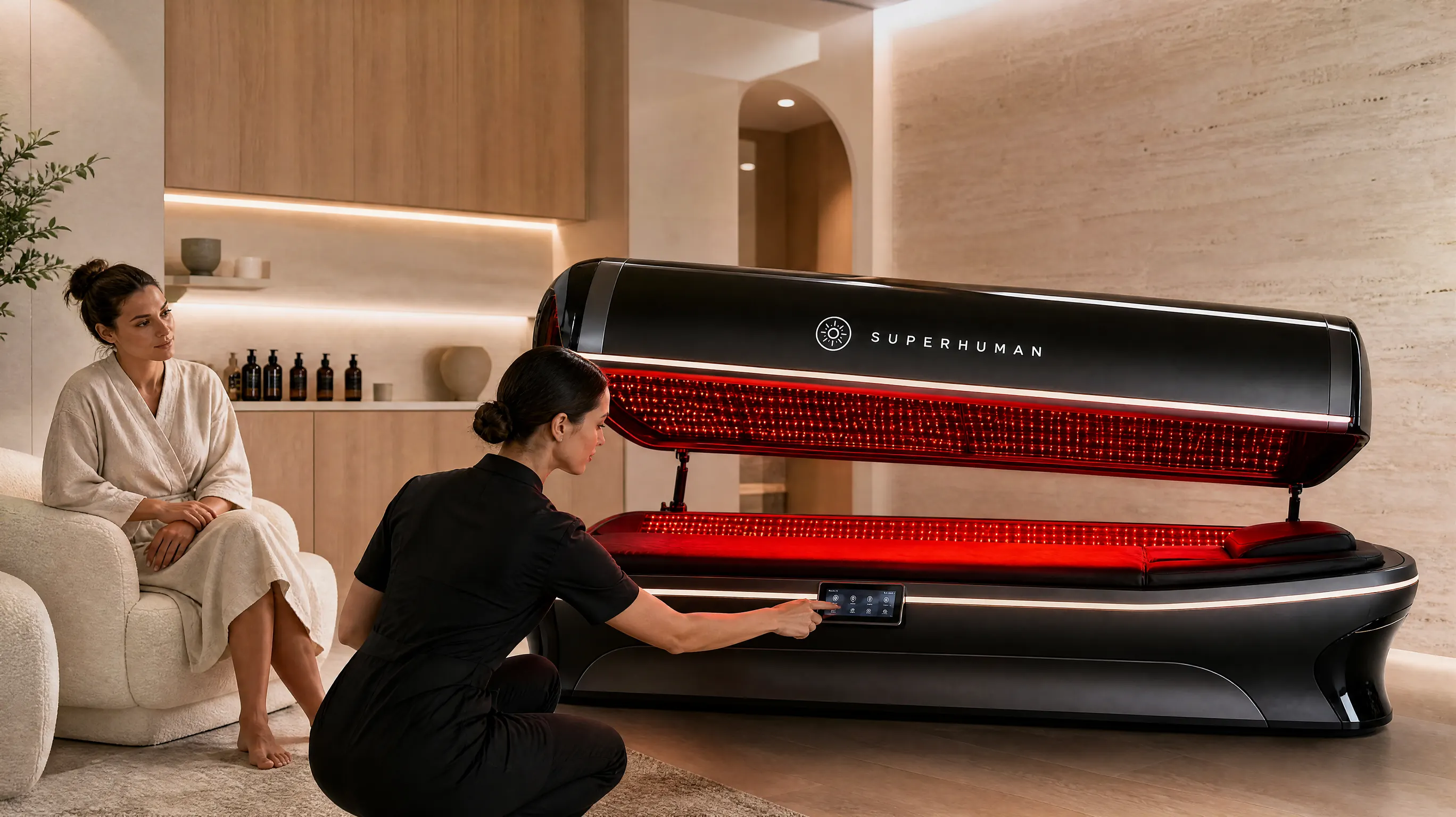
A red light therapy bed fits a med spa because it adds a service that needs almost no provider time. A guest spends 10–20 minutes in the bed, staff clean it, and your injectors and aestheticians stay booked on higher-value work. Sessions typically sell for $20–100, and the Superhuman Light R1 costs $29,900 or about $620 a month on a lease.
The difference from a day spa is the clinical setting. Guests expect medical accuracy, and regulators expect your claims to match what your devices are cleared for. This page covers pairing, claims language, protocols and documentation.
Where red light fits in a med spa menu
Red light works best as a supporting service, not the headline. It gives guests a reason to visit between larger treatments and adds value to memberships.
| Use | How it works |
|---|---|
| Stand-alone session | A 15–20 minute full-body session, booked alone. |
| Pre- or post-treatment add-on | Added to a facial, peel or other aesthetic service, where your medical director allows it. |
| Membership perk | A set number of sessions per month included in an aesthetics membership. |
| Series between treatments | A prepaid pack to keep guests visiting between quarterly treatments. |
| Wellness bundle | Paired with other wellness services such as body treatments. |
Pairing ideas to review with your medical director:
- Red light after a hydrating facial as part of a skin-appearance routine.
- A session series between chemical peel or microneedling appointments, with timing set by protocol.
- A membership tier that adds two red light sessions a month to monthly facials.
Do not assume red light suits every guest right after every procedure. Some treatments leave skin sensitive, and some guests use photosensitizing products. Timing is a clinical decision.
Claims language: stay inside the lines
The FDA regulates devices by their intended use. A light device may be marketed for a medical use only if it holds clearance for that use. Some specific devices are FDA-cleared for uses such as wrinkle reduction, adjunctive pain relief or hair growth. A clearance covers only that device and that indication.
The R1 is sold as a commercial wellness bed. We do not claim FDA clearance for the R1. So your menu, website, social posts and staff scripts should frame it as wellness, recovery and skin-appearance routines. The FDA’s General Wellness policy explains the difference between general wellness claims and disease claims.
| Acceptable framing | Avoid |
|---|---|
| “A full-body red and near-infrared light session” | “Treats acne, rosacea or psoriasis” |
| “Part of your skin-appearance routine” | “Removes wrinkles” or “builds collagen” |
| “A relaxing recovery session” | “Heals injuries” or “reduces inflammation” |
| “Research on red light is active and evolving” | “Clinically proven” or “FDA approved” |
| “Complements your facial” | “Speeds healing after your procedure” |
Med spas face extra scrutiny from medical boards, state regulators and the FTC. When in doubt, have your medical director and counsel review the copy. For a full explanation of clearance vs registration, read medical grade red light therapy.
Protocols
Write protocols before the first guest. Your medical director should sign off on them. A basic protocol set covers:
Screening. Use an intake form that asks about pregnancy, photosensitivity conditions, photosensitizing medications and topicals (such as retinoids), active cancer, photosensitive epilepsy, eye conditions and recent procedures. Define which answers need physician clearance. Our red light therapy safety guide has a screening table you can adapt.
Session settings. Pick standard presets for session length (10–20 minutes on the R1), wavelength mix and continuous or pulsed mode. Start new guests shorter. Set a maximum of one session per day unless the medical director says otherwise.
Timing around procedures. Set written waiting periods after procedures such as injectables, lasers, peels and microneedling, based on your medical director’s judgment.
Eye protection. Protective eyewear for every guest, every session. The R1 ships with an eyewear set.
Adverse events. Define what staff do if a guest reports burning, dizziness or a skin reaction, and who they escalate to.
Documentation
Good records protect the guest, the practice and the medical director. Keep:
- Intake and consent forms, signed and updated at set intervals.
- Screening notes, including any physician clearance received.
- Session logs with date, preset, length and staff member. The R1 has a built-in usage log you can match against your EMR or booking system.
- Cleaning logs for the bed and eyewear.
- Training records for every staff member who runs sessions.
- Device documents, including the regulatory and electrical documentation supplied with your written quote.
Room and staffing
The R1 is a clamshell bed that treats front and back at once. It measures 2.2 × 1.2 m and 1.1 m high closed. We recommend a room of about 3.0 × 2.2 m (about 10 × 7 ft) with ventilation or air conditioning, because the bed draws about 5.5 kW. It needs a dedicated 208–240 V single-phase circuit on a 40 A breaker. See installation for site prep.
Staff time per session is about 5–10 minutes: check-in, eyewear, start, cleaning. A trained medical assistant or front desk team member can run it under your protocols. Every R1 includes a half-day on-site training session.
Illustrative revenue
This is an illustrative example, not a forecast.
In a med spa, the bigger value often comes from retention. A membership perk that brings a guest back twice a month between treatments keeps them engaged with your practice. At $60 a session, about 11 sessions a month cover the lease.
Model your own numbers with the red light therapy bed ROI calculator. If you also run a day spa location, compare with our guide for spas.
The bed
The Superhuman Light R1 uses five wavelengths (630, 660, 810, 850 and 940 nm), about 36,000 LEDs and about 100 mW/cm² at the acrylic surface, with an independent measurement supplied with your quote. It offers continuous and pulsed modes with per-wavelength control and session presets. It uses no UV, and its LEDs are rated for 50,000+ hours.
It costs $29,900, or about $620 a month on a 60-month lease (OAC). Delivery, install, commissioning, half-day training, protective eyewear and a 2-year parts and labour warranty are included.
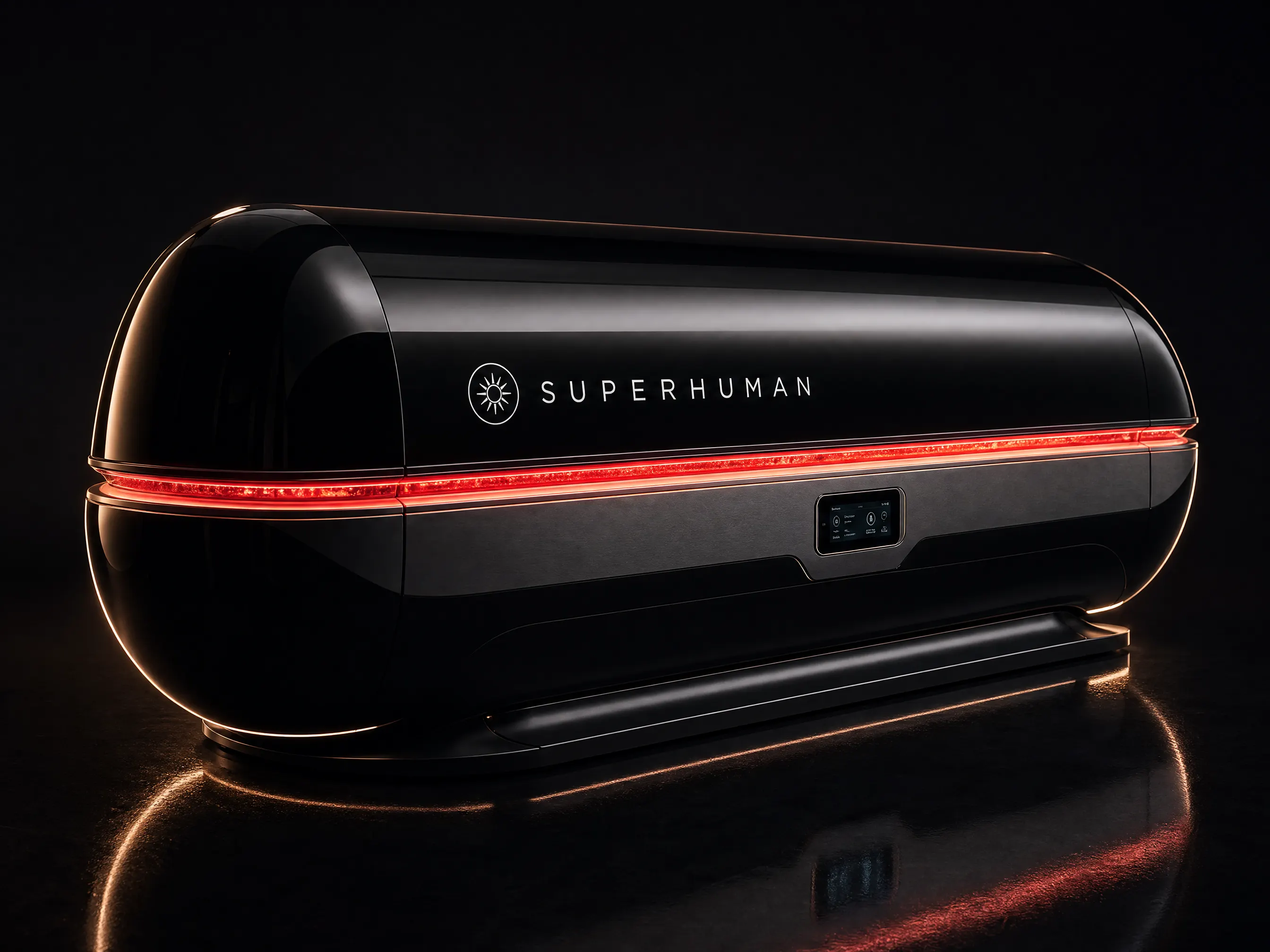
Superhuman Light R1
Full-body red light, built for a full day of bookings.
- Format
- Full-body bed
- Wavelengths
- 5 · 630–940 nm
- Session
- 10–20 min
- Power
- 240 V · 40 A
Read the full specs on the Superhuman Light R1 product page, or contact us for a written quote with documentation.