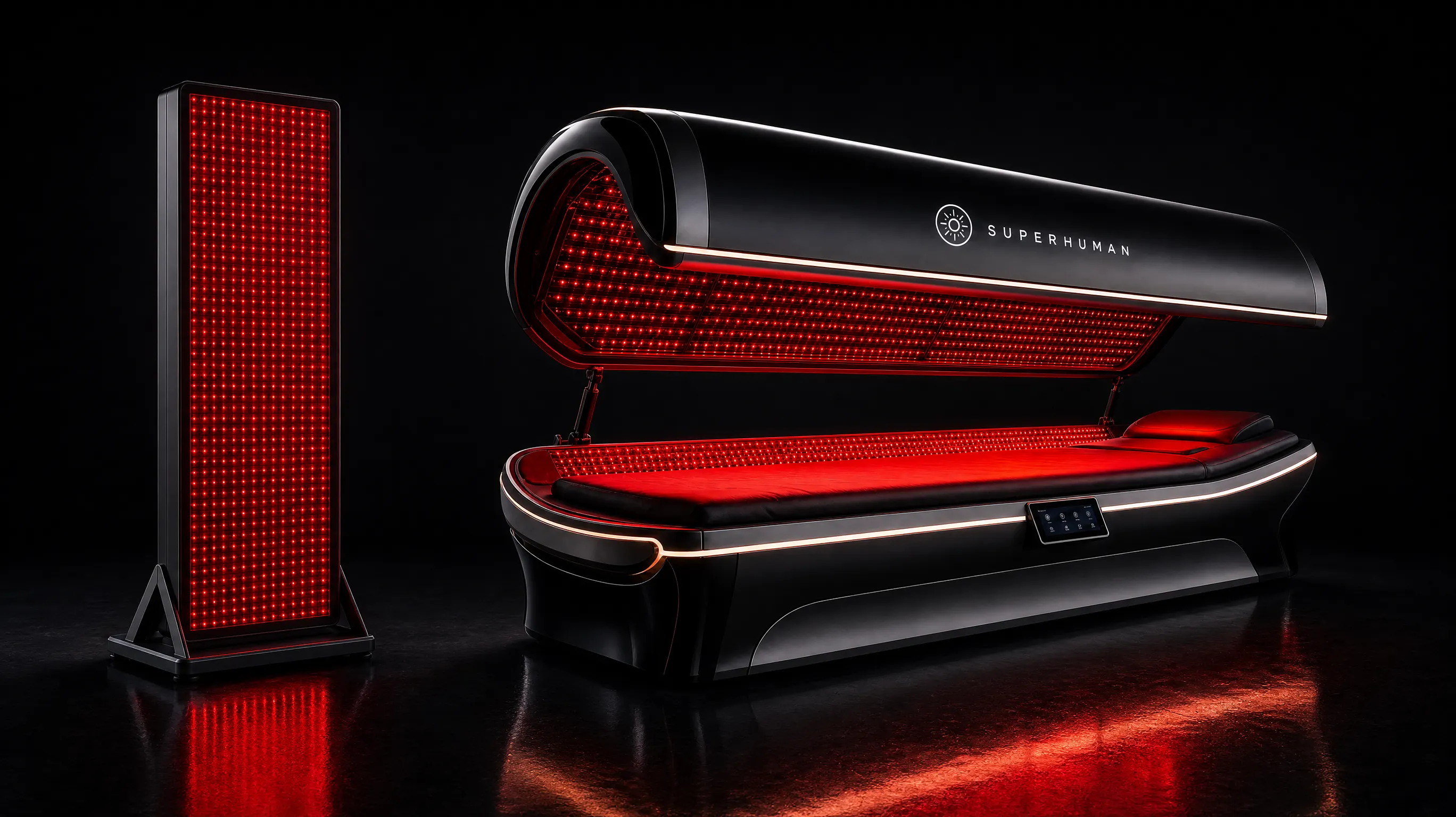
A red light therapy bed treats the whole body, front and back, in one 10–20 minute session. A panel treats one side at a time, costs a fraction of the price and fits on a wall. For a business selling full-body sessions at $40–100, a bed usually earns more per hour. For a targeted add-on or a tight budget, a panel is the smarter first buy.
Side-by-side comparison
| Factor | Commercial bed | Full-size panel |
|---|---|---|
| Coverage | Whole body, front and back at once (clamshell beds) | One side of the body per position |
| Typical session | 10–20 min | About 10 min per treatment area, plus turning |
| Guests per hour | Up to 3 (R1, including changeover) | 2–3 full-body, more for targeted sessions |
| Public price | $24,995–95,995 (see best beds) | $899–1,699 for a single panel |
| Power | 110–120 V to 240 V at 40 A, depending on model | Standard wall outlet for most models |
| Space | Bed around 2.2 × 1.2 m, room around 3.0 × 2.2 m | Wall or stand, 1–2 m clear in front |
| Staff time | Guest lies down, session runs on a preset | Guest must be positioned and may need to turn |
| Session price customers accept | $20–100 for full-body sessions | Often sold as a lower-priced or add-on service |
| Heat | Needs ventilation or AC in the room | Small, spreads into the room |
| Guest experience | Private, lying down, eyes protected | Standing or seated, more exposed |
Coverage: the biggest difference
A panel lights what faces it. Mito Red Light, for example, recommends standing 12–18 inches from its MitoPRO X panels for about 10 minutes per treatment area. A single 90 cm (3 ft) panel covers the torso and thighs on one side. To treat the back, the guest turns around. To treat head to toe in one position, you need two or more panels.
A clamshell bed puts LEDs above and below the guest. The R1 lines both the canopy and the bed with about 36,000 LEDs, so front and back get light at the same time. No turning, no staff help, no uneven dose between sides.
Some beds use a top panel over a flat bed (Vital Bed, for example, lists a 16–24 inch treatment distance). Others rely on the guest turning over. LightStim recommends 20 minutes per body side. Check this before you compare session times.
Throughput and revenue per hour
Throughput is where beds earn their price. With changeover, the R1 serves up to 3 guests an hour on 10–20 minute sessions.
A panel setup can match that for short targeted sessions. For full-body sessions, turning adds time: two 10-minute positions plus changeover is roughly 25 minutes, or about 2 guests an hour per setup.
Here is an illustrative example using the operator math from our ROI guide.
| Illustrative | Bed | Two-panel array |
|---|---|---|
| Session price | $60 | $30 (add-on pricing) |
| Sessions per day | 6 | 6 |
| Days per year | 260 | 260 |
| Annual revenue | $93,600 | $46,800 |
These are not guarantees. Your prices, local demand and opening hours drive the result. The point is that a full-body bed session can carry a higher price, and that difference quickly outweighs the equipment cost gap.
Cost per session
Equipment cost per session is the purchase price divided by the number of sessions over the equipment’s useful life. Illustrative inputs:
- Bed: $29,900 R1, 6 sessions a day, 260 days a year, 5 years = 7,800 sessions. That is about $3.83 per session. A 20-minute session uses under 2 kWh, so electricity adds roughly $0.20–0.30 at typical US commercial rates. The R1’s LEDs are rated for 50,000+ hours, far longer than 5 years at this pace.
- Two-panel array: $1,948 (Mito 750X plus 1500X), same 6 sessions a day, 260 days, 3 years = 4,680 sessions. That is about $0.42 per session, plus a few cents in power.
The panel is cheaper per session. The bed earns more per session. At $60 a session, $3.83 of equipment cost is about 6.4% of revenue. See how much a red light bed costs for lease options and running costs.
Power requirements
Most panels plug into a standard wall outlet. That makes them easy to add anywhere.
Beds vary a lot:
- 110–120 V beds: LightStim LED Bed (100–240 V, standard outlet), Prism Light Pod (110 V), MitoRECHARGE Bed (one 20 A outlet or two 15 A outlets).
- 220–240 V beds: NovoTHOR (2.4 kW, 13 A), TheraLight 360i (220 V, 30 A).
- Superhuman Light R1: 208–240 V single-phase on a dedicated 40 A circuit, about 5.5 kW.
A new 240 V circuit is a routine job for a licensed electrician, but get a quote before you buy. Our installation page lists what to check.
Space and room setup
A panel needs a wall mount or floor stand and 1–2 m of clear floor in front of it. It can share a room with other services.
A bed needs its own room. The R1 is 2.2 × 1.2 m and 1.1 m high closed. We recommend a room of at least 3.0 × 2.2 m (about 10 × 7 ft) with ventilation or AC, because a high-output bed puts heat into the room. A private room also lets guests undress for full-body exposure.
Price and financing
A full-size panel costs $899–1,699 at list price. You can pay for it with one week of add-on sessions.
A commercial entry bed costs $15,000–30,000. Premium pods cost $60,000–150,000. The R1 costs $29,900 or about $620 a month on a 60-month lease (OAC). See financing for terms. A lease turns the bed into a monthly cost you can compare directly with session revenue.
When a panel is the right choice
- You want to test demand before committing $25,000 or more.
- You offer targeted services (face, neck, knees, back) as add-ons to facials or massage.
- You have no spare room and no budget for a new circuit.
- Your guests are fine standing and turning.
Our panel ranking compares five popular models on irradiance, wavelengths, flicker and EMF.
When a bed is the right choice
- You want to sell full-body sessions as a headline service at $40–100.
- You need predictable throughput, with sessions staff can start and leave.
- You are a tanning salon, spa or recovery studio with a spare room.
- You want a private, lying-down experience that feels like a premium service.
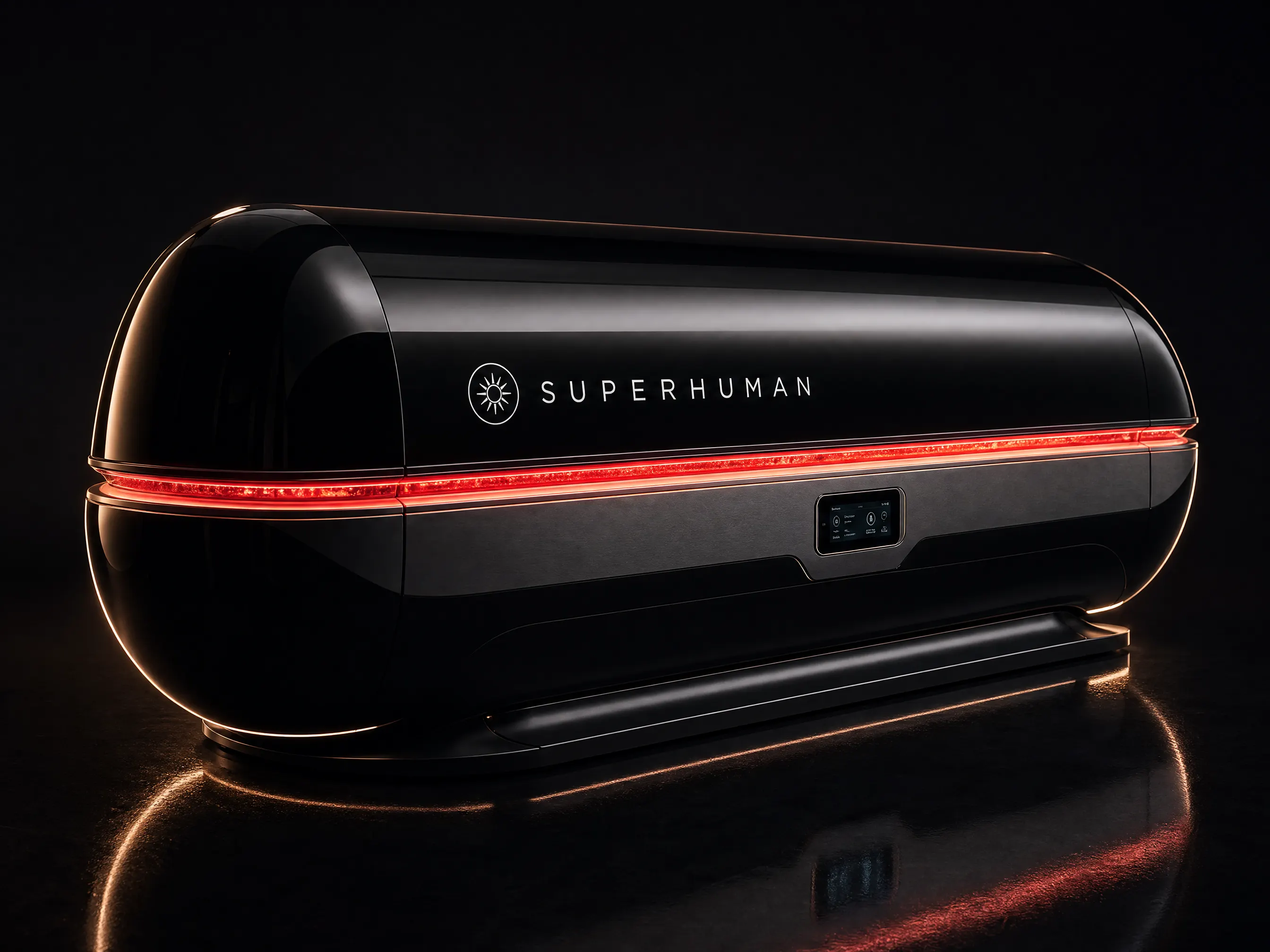
Superhuman Light R1
Full-body red light, built for a full day of bookings.
- Format
- Full-body bed
- Wavelengths
- 5 · 630–940 nm
- Session
- 10–20 min
- Power
- 240 V · 40 A
A note on what red light can and cannot claim
Neither format treats or cures anything by default. Photobiomodulation research is active and results are mixed. A few specific devices hold FDA clearance for specific uses, such as temporary relief of minor muscle and joint pain. If you want to make that kind of claim, buy a device cleared for it and check the 510(k) in the FDA database. Otherwise, market sessions as wellness, recovery and skin-appearance routines. Our safety guide covers eye protection and contraindications.
Sources
- Mito Red Light MitoPRO X (distance, session time, price): https://mitoredlight.com/products/mitopro-x-series
- Hooga HG1500 (price): https://hoogahealth.com/products/hg1500-red-light-therapy-device
- Joovv Solo 3.0 (price): https://joovv.com/products/joovv-solo-3-0
- Vital Bed (price, distance): https://vitalredlight.com/products/vital-bed
- LightStim LED Bed (power, per-side time): https://lightstim.com/products/lightstim-led-bed
- NovoTHOR specs: https://www.novothor.com/technology/
- TheraLight 360i dealer listing: https://davincimedicalusa.com/products/theralight-360i-whole-body-red-light-therapy-bed
- Prism Light Pod: https://prismlightpod.com/prism-light-pod/
- MitoRECHARGE Bed: https://mitoredforbusiness.com/products/mitoredlightbed
- FDA 510(k) database: https://www.accessdata.fda.gov/scripts/cdrh/cfdocs/cfpmn/pmn.cfm