Red light therapy devices are described by three numbers. Wavelength (nm) is the color of the light. Irradiance (mW/cm²) is how much light power reaches each square centimetre of skin. Dose (J/cm²) is the total energy delivered in a session, which is irradiance multiplied by time.
The common wavelengths are 630 and 660 nm (red) and 810, 850 and 940 nm (near-infrared). Irradiance only means something if you know the distance it was measured at. This guide explains each number and how to read a spec sheet honestly.
The five common wavelengths
Light is measured in nanometres (nm). Visible red light runs from about 620 to 750 nm. Near-infrared (NIR) starts around 750 nm and is invisible to the eye. Most red light therapy devices use LEDs at a few set points in these ranges.
| Wavelength | Band | Visible? | Notes |
|---|---|---|---|
| 630 nm | Red | Bright red | Absorbed mostly in the outer skin layers. Common in skin-appearance devices. |
| 660 nm | Red | Deep red | One of the most studied red wavelengths. Close to an absorption peak of cytochrome c oxidase. |
| 810 nm | NIR | No | Widely used in research, especially with lasers. Travels deeper than red. |
| 850 nm | NIR | Faint glow at most | Very common in LED devices. Travels deeper than red. |
| 940 nm | NIR | No | Less studied than 810 or 850 nm. Often added to widen the spectrum. |
Why combine them? Red light is absorbed closer to the surface, while near-infrared passes deeper into tissue before it is absorbed. A mix lets one device cover skin-focused and recovery-focused routines. The Superhuman Light R1 uses all five: 630, 660, 810, 850 and 940 nm, with per-wavelength control.
A note of caution: the science behind which wavelength does what is still developing. Reviews point out that studies use so many different wavelengths, powers and times that direct comparison is hard (Zein et al., 2018). Be wary of any seller who claims one wavelength “does” a specific health benefit. For the background on how red light is thought to work, see what is red light therapy.
Irradiance: power per area
Irradiance is the light power landing on each square centimetre, usually given in milliwatts per square centimetre (mW/cm²). Think of it as how bright the device is from the skin’s point of view.
It depends on:
- LED count and power. More and stronger LEDs raise output.
- LED spacing and layout. Tight spacing gives more even coverage.
- Distance to the skin. The biggest factor, covered below.
- The cover. Acrylic or glass between LEDs and skin absorbs a little light.
The R1 measures about 100 mW/cm² at the acrylic surface, which is where the guest’s body rests. An independent measurement report is supplied with your quote.
Dose: energy over time
Dose, also called fluence or energy density, is the total energy delivered to each square centimetre over a session. It is measured in joules per square centimetre (J/cm²).
The formula is simple:
Dose (J/cm²) = Irradiance (W/cm²) × Time (seconds)
Remember that 1,000 mW = 1 W. So:
| Irradiance | Time | Dose |
|---|---|---|
| 100 mW/cm² (0.1 W/cm²) | 10 min (600 s) | 60 J/cm² |
| 100 mW/cm² | 15 min (900 s) | 90 J/cm² |
| 100 mW/cm² | 20 min (1,200 s) | 120 J/cm² |
| 50 mW/cm² | 20 min | 60 J/cm² |
| 25 mW/cm² | 20 min | 30 J/cm² |
These are the numbers at the stated irradiance. Real doses vary across the body, because not every part of a guest sits the same distance from the LEDs.
More is not always better
Photobiomodulation seems to follow a biphasic dose response. A low dose may do little, a moderate dose may have an effect, and a very high dose may reduce or cancel it. This was set out in reviews by Huang and colleagues (2009, update 2011). There is no single agreed “right” dose for full-body sessions. That is why session presets, set times and sensible limits matter more than chasing the highest number.
Why measurement distance matters
Light spreads out as it travels. The further the skin is from the LEDs, the lower the irradiance. The drop is steep at close range.
This is where many spec sheets mislead. A panel brand may quote irradiance measured right against the lens, while the user stands 15 cm (6 in) or more away. The number on the box can be several times higher than what the skin actually gets.
For beds, the question is simpler but still worth asking:
- Where was it measured? At the acrylic surface (contact) or at some distance above it?
- Where on the bed? At the center, the edge, or averaged over several points?
- Canopy or base? A clamshell has two light surfaces. The canopy sits a few centimetres above the body, the base is in direct contact.
Meters: why cheap readings mislead
Many irradiance numbers online come from low-cost solar power meters. These meters are built for sunlight. They can misread narrow-band red and near-infrared LED light, often overstating it.
More reliable options are calibrated spectroradiometers or thermal power meters used by optics labs. Ask the seller what meter was used, whether it was calibrated for these wavelengths, and who took the reading. An independent lab report is the gold standard.
Continuous vs pulsed light
Many devices offer pulsed modes, where the LEDs switch on and off many times per second. Pulsing is usually described by:
- Frequency (Hz): how many pulses per second, for example 10 Hz or 40 Hz.
- Duty cycle (%): the share of time the light is on.
Pulsing changes the dose. At a 50% duty cycle, the average power is about half of continuous mode, so the dose over the same time is about half too. Some research suggests pulse parameters may influence results, but the evidence is mixed and there is no settled “best” frequency. Treat pulsed modes as a way to vary sessions, not as proof of extra benefit. The R1 supports both continuous and pulsed modes with session presets.
How to read a spec sheet honestly
Use this checklist when you compare devices. It works for a $300 panel or a $150,000 pod.
| Spec | What a good sheet gives you | Red flag |
|---|---|---|
| Wavelengths | Exact values in nm, and the mix or ratio | “Full spectrum” or vague ranges only |
| Irradiance | mW/cm² with distance, location and meter | A single big number with no method |
| Dose | Suggested session times and resulting J/cm² | “More power = faster results” |
| Coverage | Treated area, LED count, front and back | Photos only |
| UV | States no UV output | Silent on UV |
| Electrical | Voltage, amps, kW and safety listing | No electrical spec before purchase |
| Regulatory | Exact FDA status and any K number | “FDA registered” as a quality badge |
| Heat | Room size and ventilation guidance | No mention of heat |
For commercial beds, add three business specs: session length, guests per hour and running cost. The R1 runs 10–20 minute sessions, handles up to 3 guests per hour with changeover, and uses about $60–120 per month in electricity at typical commercial use.
For more on regulatory claims, read medical grade red light therapy. To see how beds from different brands stack up on these specs, see best red light therapy beds.
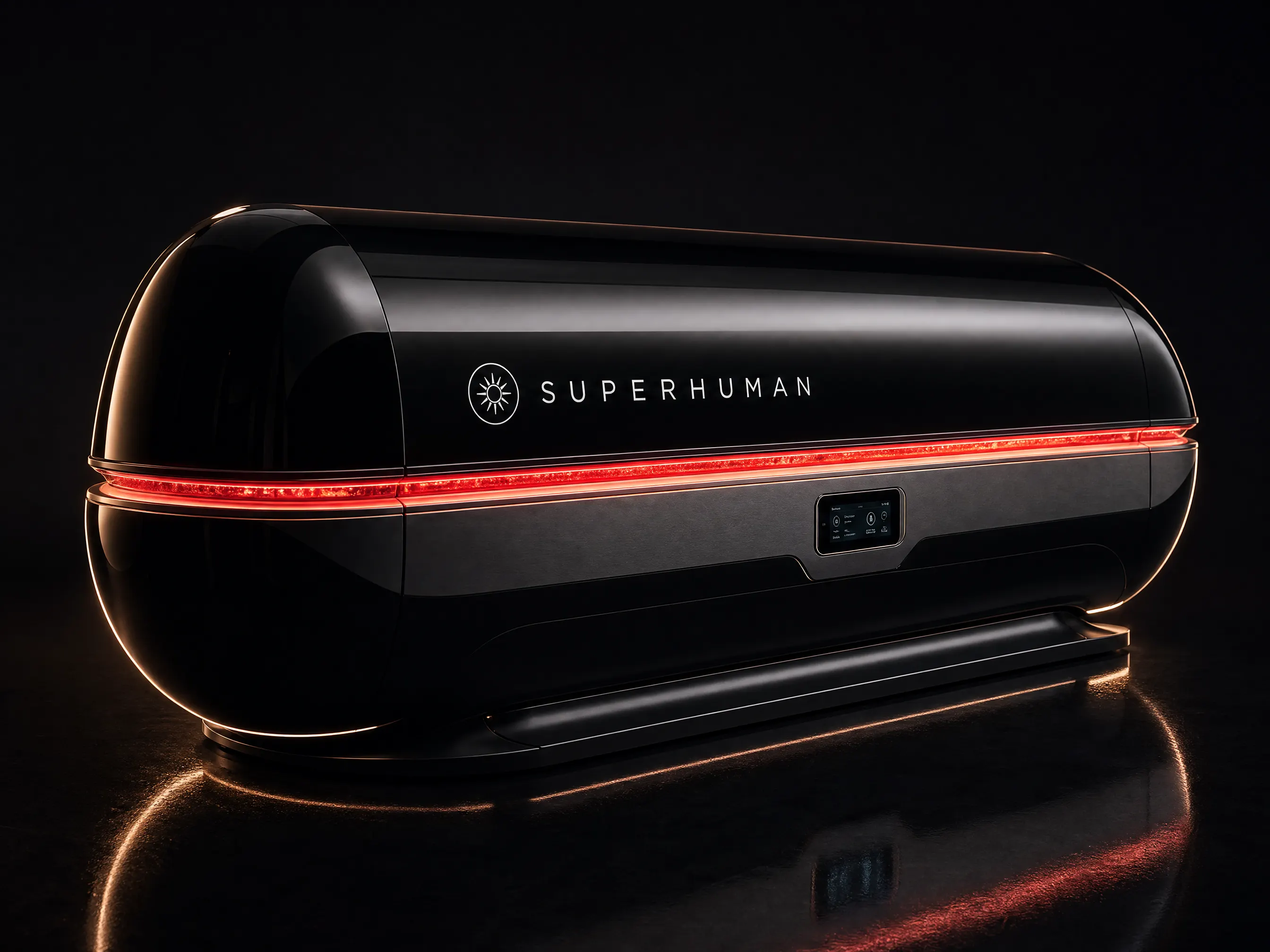
Superhuman Light R1
Full-body red light, built for a full day of bookings.
- Format
- Full-body bed
- Wavelengths
- 5 · 630–940 nm
- Session
- 10–20 min
- Power
- 240 V · 40 A
Quick reference
- nm is color. Red is 630–660 nm, near-infrared is 810–940 nm.
- mW/cm² is power at the skin. Always ask for the distance.
- J/cm² is dose. Irradiance in W/cm² × seconds.
- Pulsed at 50% duty cycle roughly halves the dose.
- Independent measurement beats marketing numbers every time.
See the full spec sheet on the Superhuman Light R1 product page.