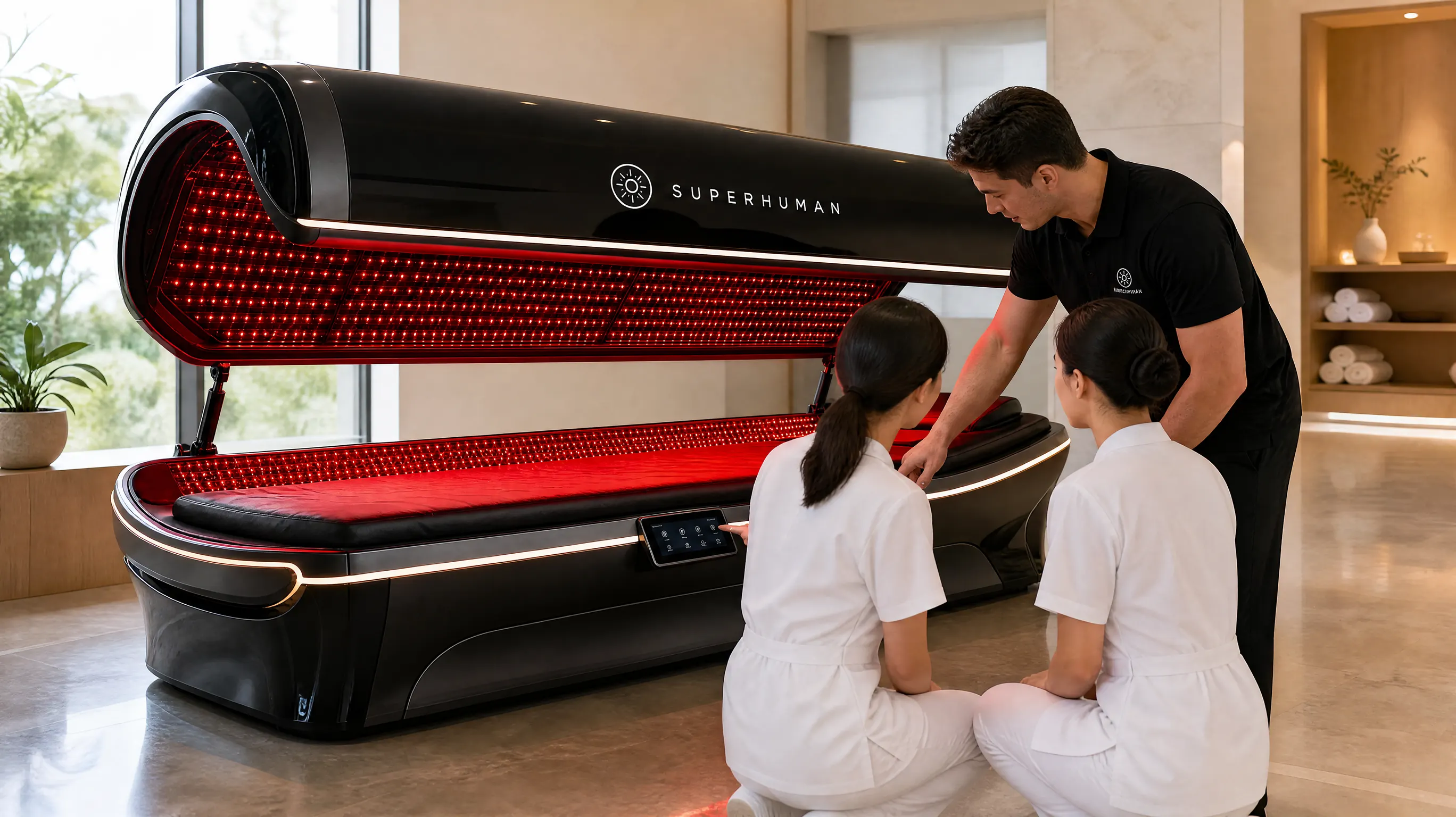
Red light therapy is generally well tolerated and uses no ultraviolet light, so it does not carry the burn and skin-cancer risks of UV tanning. It is not risk-free, though. A commercial operator needs a routine that covers eye protection, heat, guest screening, session limits, cleaning, electrical safety and staff training.
This guide sets out a practical baseline. It is general information, not medical advice. Your own policies should be reviewed by a physician or medical director, especially if you work with guests who have health conditions.
What the research says about safety
Reviews of low-level light therapy describe it as having a good safety profile at the doses typically studied, with few reported side effects (Avci et al., 2013; Chung et al., 2012). Most studies, however, used targeted devices on small areas for short times. There is much less data on full-body beds used often over long periods. That gap is a good reason to follow conservative limits and screen guests carefully.
Eye protection
Eyes are the main safety concern with high-output LED devices.
- Brightness. A full-body bed has tens of thousands of LEDs. The R1 has about 36,000. Looking straight into them is uncomfortable and not advised.
- Invisible light. Near-infrared at 810, 850 and 940 nm is invisible or nearly so. The eye does not blink or look away from light it cannot see, so natural protection does not apply.
- Standard. The IEC 62471 standard sets exposure limits for eye and skin from lamps and LED systems. Ask your supplier how the device was assessed.
What to do: give every guest protective eyewear rated for the device’s wavelengths, and make wearing it a rule, not an option. Clean eyewear between guests. The R1 includes a protective eyewear set.
Heat and comfort
LEDs are efficient, but a bed that draws about 5.5 kW puts real heat into the room. Guests also feel warmth on the skin, especially from near-infrared light.
- Plan a room with ventilation or air conditioning. For the R1 we recommend a room of about 3.0 × 2.2 m (about 10 × 7 ft).
- Keep the bed’s own fans clear.
- Tell guests they will feel warm, and that they can end the session at any time.
- Offer water, and check on guests who look flushed or light-headed after a session.
- Stop a session if a guest reports burning, pain or dizziness.
Photosensitizing medications and products
Some medicines and skin products make skin more sensitive to light. Most photosensitivity research focuses on ultraviolet light, and interactions with red and near-infrared light are less studied. Because of that uncertainty, a conservative approach is best.
The FDA has published a listing of medications that increase sensitivity to light. It is dated, but it shows the kinds of drugs involved. Common examples include:
- Some antibiotics, such as tetracyclines and sulfonamides.
- Some heart medicines, such as amiodarone.
- Topical retinoids and some acne products.
- Certain diuretics and anti-inflammatory drugs.
The FDA also notes that some antibiotics, birth control pills and benzoyl peroxide products may increase sensitivity to UV (FDA: Ultraviolet Radiation).
What to do: ask about photosensitizing medications and topical products on the intake form. If a guest says yes, ask them to check with their physician or pharmacist before booking.
Who to screen
Use an intake form for every new guest and update it periodically. These are the well-supported points to screen for. In each case, the safest policy is to require physician clearance before a session.
| Screen for | Why | Suggested policy |
|---|---|---|
| Pregnancy | Little research on full-body light in pregnancy | Physician clearance, or defer |
| Photosensitivity conditions (for example lupus or porphyria) | Skin may react to light | Physician clearance |
| Photosensitizing medications or products | Possible increased skin reaction | Check with physician or pharmacist |
| Active cancer, or cancer in the treated area | Effects on tumors are not well understood | Physician or oncologist clearance |
| Photosensitive epilepsy | Pulsed or flashing light can trigger seizures in some people | Use continuous mode only, with physician clearance |
| Eye conditions or recent eye surgery | Eyes may be more sensitive | Physician clearance |
| Heat sensitivity, or conditions affected by heat | Beds produce warmth | Shorter sessions, physician advice |
| Under 18 | Parental consent and supervision | Follow your local rules and insurer’s policy |
Photobiomodulation is sometimes studied in cancer care, for example for side effects of cancer treatment, but that happens under medical supervision with specific protocols. A wellness business should not make that call for a guest.
Session limits
There is no single agreed dose for full-body sessions, and photobiomodulation appears to follow a biphasic dose response: more light is not always better, and very high doses may reduce any effect (Huang et al., 2011).
Sensible operator rules:
- Use the maker’s session presets. R1 sessions run 10–20 minutes.
- Start new guests on shorter sessions.
- Allow one full-body session per guest per day unless a medical director sets a different protocol.
- Do not let guests stack sessions back to back.
- Log each session. The R1 has a built-in usage log you can match to your booking system.
For how session time turns into dose, see red light therapy wavelengths.
Cleaning and hygiene
Guests lie directly on the acrylic, so cleaning between every session is essential.
- Wipe the acrylic surfaces, headrest and handles after each guest.
- Use a cleaner approved by the bed’s maker. Some alcohol-based and harsh chemical cleaners can cloud or crack acrylic over time.
- Clean and disinfect shared eyewear, or offer single-use covers.
- Allow surfaces to dry before the next guest.
- Do a deeper clean at the end of each day, including around vents and fans.
Build the cleaning time into your schedule. With changeover included, one R1 serves up to about 3 guests per hour.
Electrical safety
A commercial red light bed is a large electrical appliance. Treat it like one.
- Dedicated circuit. The R1 needs 208–240 V single-phase on a dedicated 40 A breaker. Do not share the circuit with other equipment.
- Licensed electrician. Have the circuit installed and inspected to local code. We send an electrical spec sheet before delivery. See installation.
- Safety listing. Ask for the device’s electrical safety listing and test standards. Regulatory and electrical documentation for the R1 is supplied with your written quote.
- No DIY repairs. Only trained technicians should open panels. See service and warranty.
- Daily check. Look for damaged cords, error codes, dead LED zones or unusual smells before opening.
For the difference between a safety listing and FDA clearance, read medical grade red light therapy.
Staff training
Every staff member who books or runs sessions should know:
- How to walk a guest through the intake form and when to ask for physician clearance.
- How to start, pause and stop the bed, including the emergency stop.
- The eyewear rule and how to clean eyewear.
- Session presets and limits.
- The cleaning routine and approved products.
- What to say, and what not to say, about benefits. No claims that red light treats, cures or heals anything.
- What to do if a guest feels unwell.
Every R1 includes a half-day on-site training session at install.
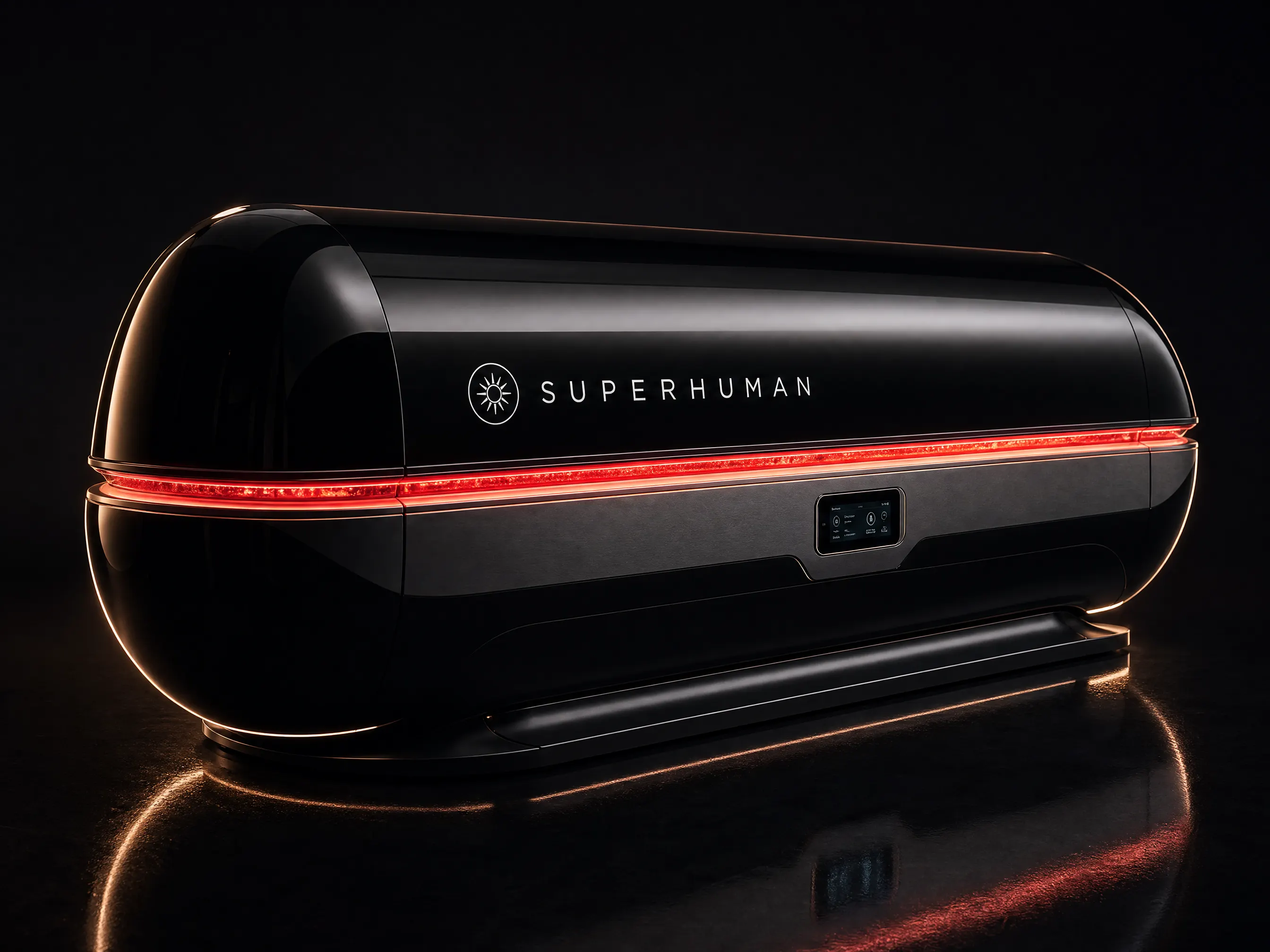
Superhuman Light R1
Full-body red light, built for a full day of bookings.
- Format
- Full-body bed
- Wavelengths
- 5 · 630–940 nm
- Session
- 10–20 min
- Power
- 240 V · 40 A
Safety checklist
- Intake form with medication and condition questions
- Physician clearance policy for the groups above
- Protective eyewear for every guest, every session
- Ventilated or air-conditioned room
- Session presets and a one-per-day limit
- Cleaning between guests with approved products
- Dedicated circuit installed by a licensed electrician
- Trained staff and written records
See how the R1 is built and what ships with it on the Superhuman Light R1 product page.