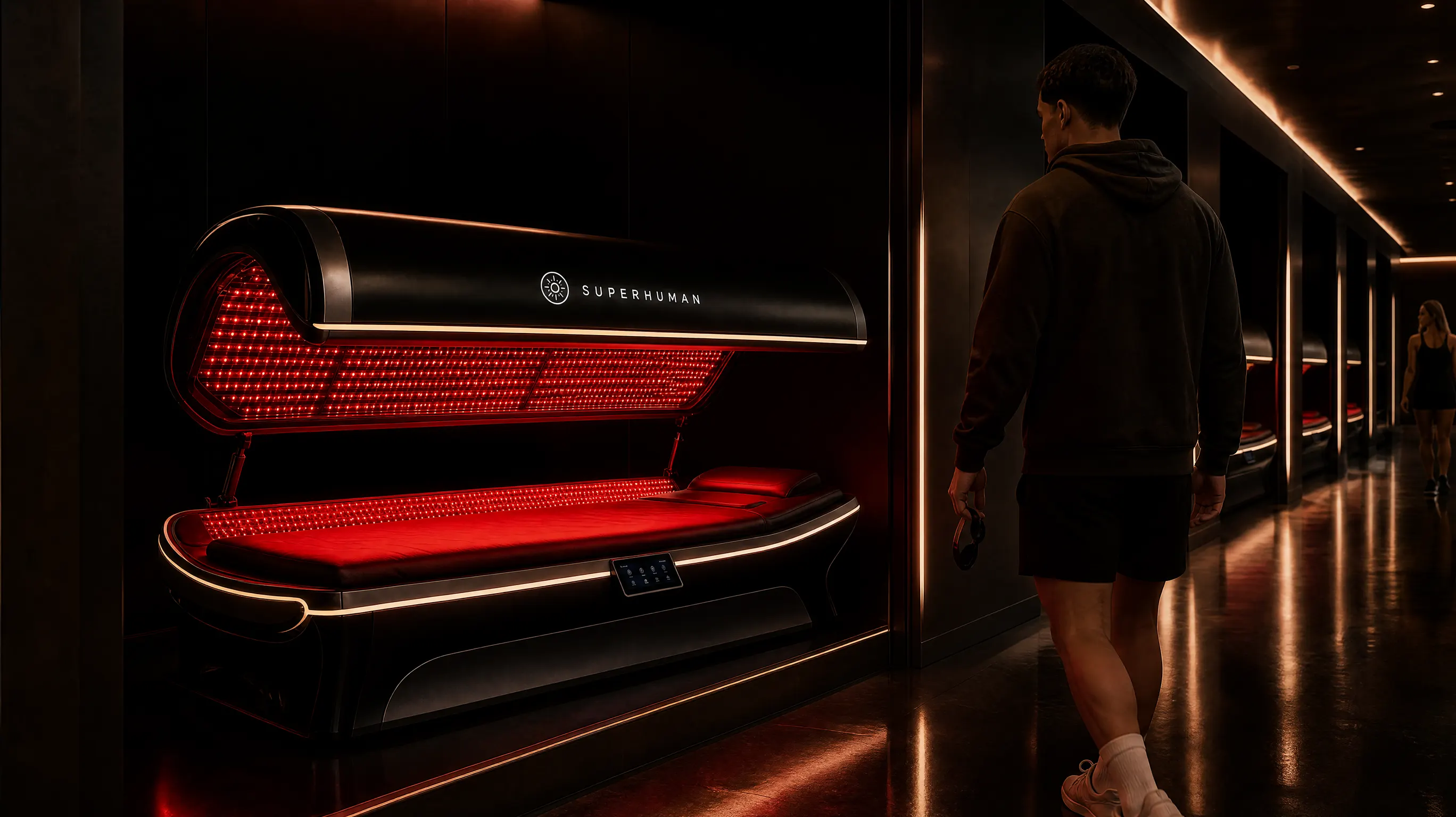
A red light therapy bed uses red and near-infrared LEDs, emits no ultraviolet (UV) light and does not tan the skin. A tanning bed uses UV lamps to cause a tan and is regulated by the FDA as a sunlamp product. The two look alike and often share a salon floor, but they differ in purpose, regulation, parts and running cost.
The short version
| Factor | Red light therapy bed | UV tanning bed |
|---|---|---|
| Light source | Red and near-infrared LEDs (about 630–940 nm) | UV fluorescent lamps and sometimes high-pressure bulbs (UVA, often UVB) |
| UV output | None | Yes, by design |
| Result guests pay for | Wellness, recovery and skin-appearance routine | A tan |
| FDA category | Depends on the device and its claims | Sunlamp product, Class II since 2014 |
| Under-18 warning required | No federal sunlamp warning applies | Yes, black-box label on every unit |
| Consumables | No lamps to replace; LEDs rated tens of thousands of hours | UV lamps and acrylics replaced on a schedule |
| Session length | 10–20 min on most beds | Set by the bed’s exposure schedule |
| Skin type limits | None related to UV | Exposure schedule by skin type |
Purpose: tan vs no tan
A tan is the skin’s response to UV damage. The FDA puts it plainly: “There is no such thing as a safe tan.” The pigment change is “a sign of damage”, and a tan gives an SPF of only about 2 to 4.
Red light beds use a different part of the spectrum. Red light sits at about 630–670 nm and near-infrared at about 810–940 nm. Neither causes a tan. The science term is photobiomodulation. Research points to mitochondria, specifically an enzyme called cytochrome c oxidase, as a main target, with a biphasic dose response where too much light can reduce the effect (Hamblin, AIMS Biophysics, 2017). Clinical results are mixed and research is ongoing. A few specific LED devices hold FDA clearance for narrow uses, such as temporary relief of minor muscle and joint pain. Red light in general is not proven to treat any condition. Our what is red light therapy guide covers the research in more detail.
For a salon, that means different customers and a different pitch. Tanning is sold as a look. Red light is sold as a wellness, recovery or skin-appearance routine that works in any season, for any skin type, with no tan.
Regulation: the big gap
Tanning beds
The FDA reclassified sunlamp products from Class I to Class II in 2014. Under the special controls:
- Every sunlamp product must carry a black-box warning that it should not be used by anyone under 18.
- Units need an accurate timer, an emergency stop control, an exposure schedule and protective goggles.
- Makers need FDA premarket review before selling new sunlamp products.
The FDA has also proposed rules that would stop tanning facilities from serving under-18s and require a signed risk acknowledgement from adult customers. Many states add their own rules on age, consent forms, operator training and inspections.
Red light beds
A bed with no UV output is not a sunlamp product, so the federal sunlamp rules above do not apply. How an LED bed is regulated depends on its claims. Some beds hold a 510(k) clearance for a specific indication. Others are sold as general wellness products. See our medical grade guide for what “cleared” and “registered” really mean.
For a salon, the practical result is simple. A red light bed adds a service with no UV age restrictions, no skin-type exposure schedule and no UV consent forms. You still need to follow local business, electrical and health rules, and guests should wear eye protection. Check with your state and city before you open a new service.
Bulbs vs LEDs
A UV tanning bed uses fluorescent lamps that emit UVA and, in most beds, some UVB. The FDA notes that “most lamps emit both UVA and UVB radiation, some emit only UVA.” Output drops as lamps age, so salons replace them on the maker’s schedule. Acrylic shields also wear and need replacement.
A red light bed uses LEDs. The Superhuman Light R1 uses about 36,000 LEDs across five wavelengths: 630, 660, 810, 850 and 940 nm. They are rated for 50,000+ hours. At 10 hours a day, six days a week, that is more than 15 years. There are no lamps to reorder.
Running cost
Tanning bed running costs include electricity, lamp changes, acrylic replacement and cleaning. The lamp change is the recurring bill that salon owners know well.
A red light bed’s main running cost is electricity. The R1 draws about 5.5 kW. A 20-minute session uses under 2 kWh, which works out to roughly $60–120 a month at typical commercial use. With no lamps to buy, the cost per session is a few cents in power.
The upfront price differs by model. The R1 costs $29,900, or about $620 a month on a 60-month lease (OAC), with delivery, installation, training and a 2-year parts and labour warranty included. See the full cost guide.
Power and room setup
Many commercial tanning beds already run on 208–240 V circuits. That makes a tanning salon one of the easiest places to add a red light bed.
The R1 needs 208–240 V single-phase on a dedicated 40 A circuit. It measures 2.2 × 1.2 m and 1.1 m high closed. We recommend a room of at least 3.0 × 2.2 m with ventilation or AC. If you retire an old tanning bed, its room and circuit may be close to what you need. Have your electrician confirm the breaker and wire size. Our installation page lists the checks.
How tanning salons add red light
Tanning salons are already adding UV-free light. Two public examples:
- Palm Beach Tan, a large US chain, offers LightStim LED Bed sessions at select locations. LightStim’s bed is FDA cleared for temporary relief of minor muscle and joint pain and related uses.
- Ergoline, part of the JK Group, sells hybrid tanning units such as the Vitality Balance with a “Pure Beauty” program that “emits only red Beauty Light”, plus mixed red and UV programs.
Common ways salons use a dedicated red light bed:
- Replace a low-use UV bed. Swap a bed that sits empty in summer for a service that sells year-round.
- Sell it as a separate service. A standalone red light session, often in a monthly membership.
- Bundle it. Offer red light to guests who do not tan, for example clients with very fair skin or those who have stopped UV tanning.
- Open it to under-18s where local rules allow. UV age limits do not apply to a UV-free bed, but check your local rules and get parental consent.
Our tanning salon guide covers pricing, memberships and room layout in more detail.
Which one should your salon buy?
If your business is tanning, keep your UV beds for guests who want a tan. Add a red light bed to serve guests who do not want UV, and to fill slow seasons. If you are a spa, gym or recovery studio, a red light bed is the only one of the two that fits your brand and your rules.
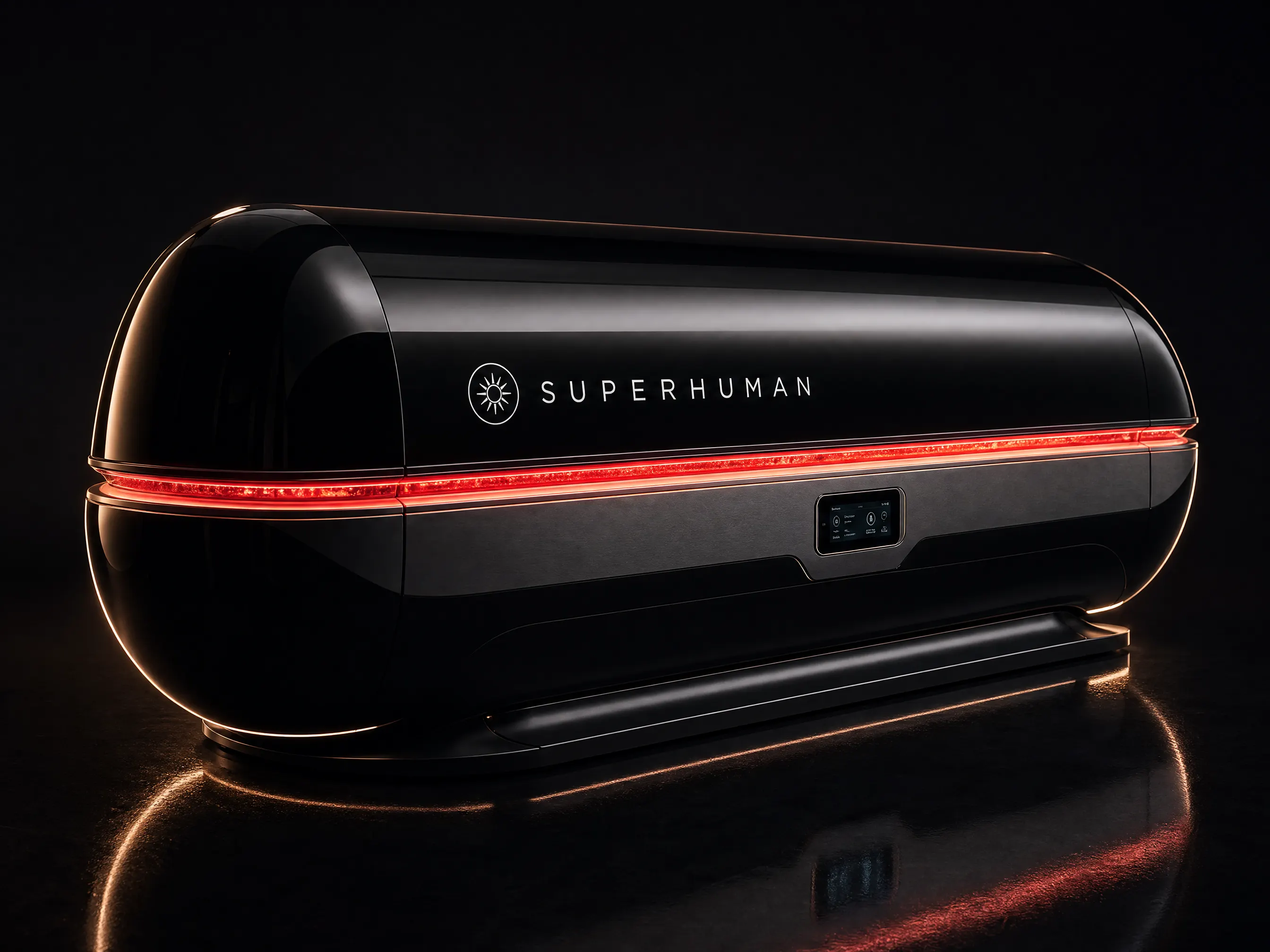
Superhuman Light R1
Full-body red light, built for a full day of bookings.
- Format
- Full-body bed
- Wavelengths
- 5 · 630–940 nm
- Session
- 10–20 min
- Power
- 240 V · 40 A
Sources
- FDA, The Risks of Tanning: https://www.fda.gov/radiation-emitting-products/tanning/risks-tanning
- FDA, Tanning Products (Class II, labeling, controls): https://www.fda.gov/radiation-emitting-products/tanning/tanning-products
- Federal Register, 2014 reclassification of sunlamp products: https://www.federalregister.gov/documents/2014/06/02/2014-12546/general-and-plastic-surgery-devices-reclassification-of-ultraviolet-lamps-for-tanning-henceforth-to
- Hamblin MR, Mechanisms and applications of the anti-inflammatory effects of photobiomodulation, AIMS Biophysics 2017: http://www.aimspress.com/article/10.3934/biophy.2017.3.337
- Palm Beach Tan, LightStim: https://palmbeachtan.com/wellness/lightstim
- LightStim LED Bed: https://lightstim.com/products/lightstim-led-bed
- Ergoline Vitality Balance: https://ergoline.de/en/products/vitality-balance/